Portraits of Soldiers Before, During, and After War
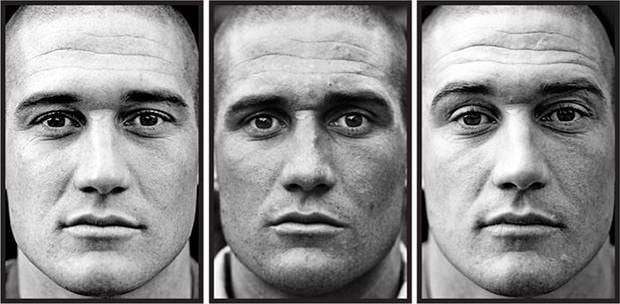
 

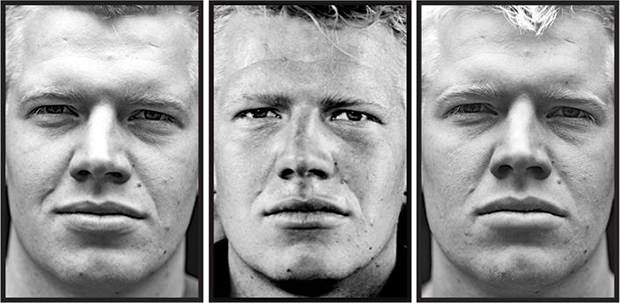
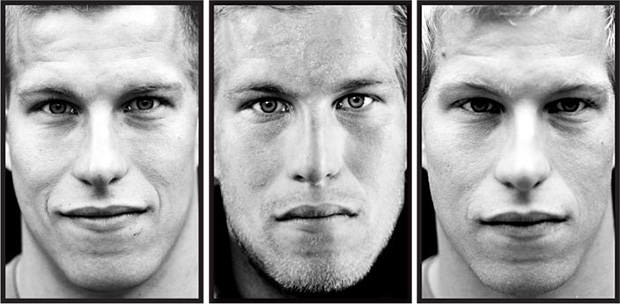
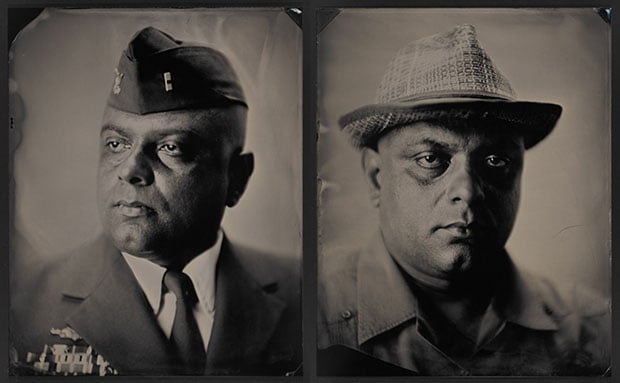
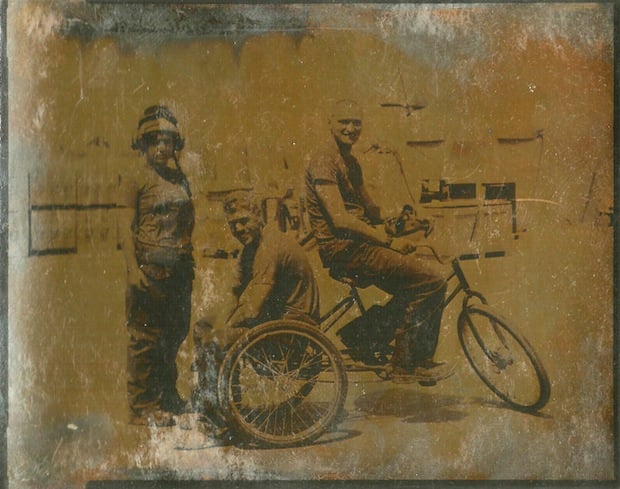
For her project titled Marked, photographer Claire Felicie shot close-up portraits of the marines in the 13th infantry company of the Royal Netherlands Marine Corps before, during, and after their deployment from 2009-2010. She then arranged the portraits into haunting triptychs that show the toll war has on a person’s eyes and face.
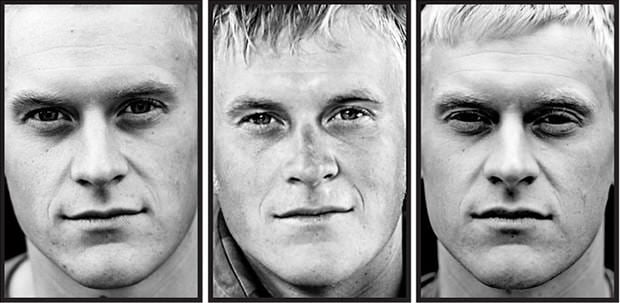
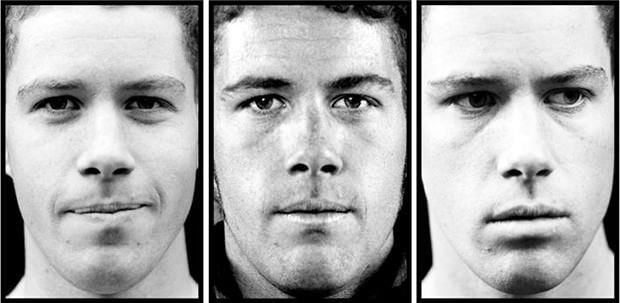
Marked by Claire Felicie (via lensculture)


Image credits: Photographs by Claire Felicie and used with permission


  • Anonymous

    I don’t see that, sorry.The difference in facial expressions is minimal and more or less inevitable.

    Don’t get me wrong, I like the before/after concept a lot, I just think that the result isn’t exactly striking. Smirk – no smirk,  is something you can do in one session. A little change of light and contrast and there goes the glow as well. You don’t need a soldier or even war for that.
    She should have gotten “better” faces for that special purpose. 

  • Nick

    no one forced them to go to war, so why should i feel bad for them?

  • Lolamadden

    I think the smirk comes from that boyish sense of them embarking on an
    adventure, that sense of the unknown. That’s what makes the during and
    after shot so moving. I personally get the sense that some of the
    during portraits show bewilderment, just
    trying to get through today and, most chillingly, intent focus. The most haunting and  upsetting for me is that there’s no relief in those after portraits.
    There’s no sense of, like, “OK that’s behind me now.” The third after
    portrait from the top, where he’s looking away, gives me the sense he’s
    reflecting, and it ain’t pleasant childhood
    memories he’s got in mind.

    Yes, the photos are edited. Those who suggest this project is slanted are correct, but are foolish to think any photo essay is not. Isn’t that what media is? Like, on a really basic level, aren’t we pointing out “Hey, look at this! Look at what I’m seeing here” [even if it's *just* a magnificent sunset while on honeymoon].

    I buy it that Ms. Felicie spent time with these men, and chose these images to tell the story of what she saw, heard, felt, etc. If she didn’t and these images were, say, artistic renditions, could we blame her for creating a visual series that tells the story which we hear in the news about soldiers returning from war?

    As to comments about soldiers being paid killers who are not at all forced to go off to war, yes, one could make that argument. However, I would reserve judgement until I found myself in the situation of needing to put food on the table for my family and having to choose between an employer such as Wal-Mart, the drug dealer down the street, or the armed forces. I’ve been fortunate not to have been in that position.

    BTW Jamie Weir, ‘”I can do this” to “I had to do that”‘ is a very eloquent
    way to describe what you’re seeing in this series of portraits. Thx.

  • Carlos J Latonga

    Nice concept, bad execution. The rigors of combat and the effect on people is a tangible “before and after” experience that is being documented in very powerful ways right now. There was a great show at the Getty in LA of images from a MASH unit for the troops in Iraq after the invasion and it was unbelievable how much torment you could feel from the shots. But I could do this with football players before, during, and after a game. I believe there is a warrior dharma in this world and young men go through a transformation when they face the reality of war. I have seen the cold hard faces of men from special forces and I don’t need a before to recognise the resignation there. But these men still have smiles they can show and not all are victims of their chosen occupation. These images are so subtle that they reveal more about the viewer’s pre-conceptions than the actual horror of war.

  • Mortgoth

    The first and third photos are lit differently than the second frame, where here the photographer managed to light the eyes and each portrait (with the exception of the top one) is consistently illuminated from both sides, thus altering the shape of the face. I recall being taught in photography class that lighting on both sides was the method to create a more ominous portrait. Note the shadow line in the center of the nose and face which tells you where the light was placed. Not that this was intentional on the part of the photographer- the lighting on the 1st and third photos of each set is uneven across the board. Don’t read too much into the “dead” eyes in the third frames- they are in a shadow (as were the first, incidentally), with the lighting source directly above. It’s funny that although the second photos appear more open and “alive” due to the reflections in the eyes, people adhere to the concept of the toll of war, as was ascribed to the series, and choose to see increased torment as the series progresses.

  • Amy Patnaude

    it looks like the pictures were all taken with just different lighting…yes there faces look a little more worn…but yea…lighting is different in the second one which makes their eyes glow…and the last one looks really hazy…just saying i understand you change when your in war and such..but these pictures are not accurately portraying that because they are not in the same way each time..its like doing an experiment but changing the conditions every time you try it and saying you got accurate results

  • Zen Rider

    How can I explain the obvious. The difference is devastatingly haunting.

  • Meluda

    This isn’t about different lighting.  Some of you truly don’t understand.  I’ve sent my husband off to war three times, and I’m about to send him off for a 4th time next summer.  Every picture of him taken in the dessert, no matter which country, shows his face tan, weathered and dirty!  My husband does not get to take a shower every day.  Or even every other day.  Sometimes he must go a week (or longer) without showering, and his main source of bathing comes from Wet Wipes.  Add the dirt to the constant glare of the sun AND the fact that there is sand everywhere, and his face changes.  He’s covered in sand, he’s covered in dirt and he’s got the sun on his face.  This isn’t about different lighting.  This is about being weathered during war.  Yes, my husband is in the profession of arms.  It is NOT for everyone and I don’t expect people who did not choose this profession to completely understand why soldiers choose the life they do.  My husband is not a killer.  He has not killed anyone. We are not asking ANYONE to feel badly for us.  This is what he wants to do.  This is what he loves.  This is the life he chose.  Don’t feel sorry for us.  Don’t feel bad for us.  And is he different when he comes home?.  You’d better believe it.

  • truthsayer 1

    How could you not be different returning home as a still young man after seeing others killed, maybe your best friends, maybe women or children.  Maybe after killing others.  

    The first set of faces is calm, at peace, maybe smirking, maybe smiling; the second set shows a kind of alertness, a hypersensitivity, a embodied presence in the moment.  The third shows an absence.  Nobody is home in some of those last faces, the eyes are hooded or blank, the expressions hidden.  

    My late husband fought in Viet Nam.  He was a photographer and writer who was almost drafted off the streets of Haight Ashbury in the 60′s after completing his B.A. and becoming a hippie.  Instead, as an Air Force brat, he enlisted and took documentaries of action for the U.S.  I have his writing from before and after.  He was a loving, open man who came back closed and haunted.  Every night of his life, his voice ramped up as he dreamed and unless I was awake enough to stop him, began screaming.  He never talked about what happened there and he never watched a war movie.  

  • guest

    imagine how the innocent dead people from iraq, afghanistan etc feel.

  • TL

    I think some people are missing the point.  Nobody is arguing whether or not war changes you because everybody agrees it does, and devastatingly so.  

    I have to agree with the people above that between the differences in lighting and selection of shots, it doesn’t fairly depict the affect of war.  In basically all of these shots I feel if the 2nd and 3rd images were swapped, I would still read into it the same way.  If you walk into something already knowing what you hope to find.. you will find it.

  • TL

    But hey.. people are talking about it so I guess that’s a win for Claire.

  • Dave

    Unfortunately it looks too much like the photographer forced her agenda. People that come back from war still have the ability to smile, smirk, laugh, frown, and have  blank gaze. It is actually really unfair to anyone who has survived war to suggest that they are forever frozen in this dead stare. The photographer created the idea in her head and then used photography to perpetuate the lie.

  • http://twitter.com/scottnelle Scott Nelle

    Look at the eyes. Forget the minimal changes to the rest of the face. The change in the eyes tells a story, and it’s not the same for each man.

  • ai

    from left to right they look relaxed, alert, detached.

  • LittleFeistyOne

    The difference, Dave, is that your friend has had decades to process his emotions and reconcile (or not) who he is with the things he had to do at war. These men haven’t had that time and it’s obvious on their faces. Aside from the lighting or processing I see distinct differences in the set of these men’s eyes. Trauma changes people and commonly those changes are evident in the eyes. 

  • Dave

    You, also, have been duped by the photographers agenda. Even modern soldiers have the ability to show more than one emotion. To say they can only be photographed with sullen expressions is doing them no favors.

  • http://twitter.com/Soiden Sebastián Soto

    It’s kind of funny how you talk about different lightings, when I only see that in the middle photo. If I forget about that one, and only look at the first and the last ones, I see the powerful change in their eyes.

  • Laochailan

    I’ve read through the previous 68 comments (which, as of this moment, is all of them), and seen several different viewpoints. Some have been critiques of technique, some have been comments on political agendas, some on the effects of war itself. There have been comments in support of war, and those against it. There has been ignorance and opinion, some positive, some negative.

    What I have not seen has been the thoughts or opinions of someone who has actually *been* in combat, in war. (I do acknowledge those posted by wives and family, but there is still a factor of remove from the experience.)

    I am a veteran of the first Gulf War, back in 1991. I have both done and seen things that have made substantial changes in my life. I suffer from PTSD. You could ask my family if I changed between the time I saw them last and the time I came back from the war. In every instance that I can recall the answer has always been that I had. You could ask my wife if I still have nightmares after twenty years. I still do.

    There are differences in the portraits. I see them despite the high contrast (which, to be honest, I am not a fan of, but I understand why the photographer chose to use it). I won’t try to tell you what those differences are, since many others have done so in those 68 comments. If you cannot see them, if you choose *not* to see them, that’s just the way it is for you. This in no way does not mean they do not exist at all.

    War changes people. Combat changes people. Sometimes that can be seen in photographs. Sometimes it can’t. I think Claire Felicie has something here, and has chosen to present it in a manner that highlights something that is often very hard to see in the first place. I applaud her efforts to do so.

    I’m not a follower of this site, and only comment here as a result of another friend linking to this piece. Commenting is not something I do often. Sometimes, however, I feel it is important enough to bring up a viewpoint that perhaps hadn’t been considered.

  • http://pulse.yahoo.com/_G3LTBW2MECXCZQD27JFTPI2BXA Recovering Democrat

    The eyes are always brighter, wider and expressions are most alert in the “during war” photos. 

  • Saddened

    Wow, I am amazed at the lack of compassion and empathy of some of you.  That is pathetic and obvious that you have never seen anything horrible happen in your lifetime.  Sad, just completely sad.

  • Dave

    What’s sad is you people that think their faces are stuck this way. NEWS FLASH: Soldiers returning from war have more than one expression! And they even still remember how to smile! And they are NOT turned into robots! Be fair to them please, and be a little more intelligent for the rest of us!

  • Xxxkupo

    They all lost the smile that was shown in their eyes

  • Samedamnbeaver

    am ex air force crew chief you can see it the eyes

  • Frank

    It never ceases to amaze me how insensitive, stupid, or just plain ignorant some people can be.  If you cant see the obvious differences in their eyes alone, why even bother to comment and waste everyone else time, and show your ineptitude to boot….furthermore, whether the military member is from the U.S., Canada, or wherever, we are all working together as a team for a common goal.   

  • http://twitter.com/barryrutherford Barry Rutherford

    I see a definite difference .  a look, a kind of cynical attitude ingrained into the facial expression

  • Eyore109

    Just an idea, but maybe you could focus on the point the photographer was trying to make. We all know that soldiers can smile and laugh and even live normal lives after war. No one is that stupid. I think the point that has been quite well made is that they went to war as hopefull, happy optimistic young men who smiled easily, and when they returned, they were less so.

    Surely that’s really the only point?

  • Dave

    If you read some of these comments you will see that yes, some people ARE that stupid.

    ” maybe you could focus on the point the photographer was trying to make.”

    What you have pointed out is exactly what I have been saying: The photographer had an agenda and forced it with these images. You could easily reverse the order of these images, or even randomly mix them up, and it could represent the fleeting expression of that moment. Your expressions change drastically throughout the day and can include any of these looks, before, during, after or even if you have never been to war. The photographer started out with a concept….preconceived. She then went about taking pictures to support her preconceived idea. The photographer has duped you and others into believing that war has altered the soldiers ability to ever smile again….and that is not fair to them. Some people take bait easier I suppose.

  • Dave

    Congratulations, you bit the worm the photographer dangled in front of you.

  • Hugsyaback

    I can see the hopeless,pure disgust,regret, loathing, and indifference.
    The third soldier changed the least because you can still see the humanity in his eyes a quality I think the other might have lost to save their sanity

  • Peter

    None of these men were forced to join the military.  Heading to Afghanistan or Iraq is NOT the same as enlisting to zee Germans in WWII.  If they didn’t want to kill people, why did they join?  Is it just me, or are people stupid when they say things like “talk to a person who has had to kill someone?”  NO ONE has to kill anybody.  They choose too.

  • Peter

    Flash was used for effect in the middle photos.  In other words, this photographer injected their own biases and feelings into what could be a great project if done properly and if it adhered to proper documentary techniques (same camera, same light, same time of day, etc).

  • http://www.facebook.com/BrianAnim Brian Kruise

    Anyone else mad that the title says soldiers but the photos are of marines? I know most marines would be.