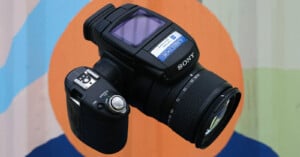



Sony has been quite mum with regards to their upcoming ultra-compact camera. However, they’ve begun releasing some teasers to give us a better idea of what’s to come, including the above YouTube video and the following screenshots of the touchscreen interface:
Here’s what we know about the system so far:
It will be an interchangeable lens system boasting a DSLR quality sensor and HD video recording capability. Controlling the camera settings and features will mostly be done through a large, touchscreen LCD interface on the back. The camera will support both RAW and JPEG modes.
Now onto speculation…
Based on the concept camera shown at PMA, and the camera icon shown in the screenshots, it looks as if the camera will have a traditional point-and-shoot design, rather than the mini-DSLR design many micro four-thirds cameras are going for. Also, the camera will likely use MemoryStick memory cards (based on the MS-shaped icon in the screenshot).
Is there anything else you can deduce from the screenshots Sony released?
Hallmark Cards recently held a photography competition in the UK called “The Picture of Motherhood“, inviting people to enter photographs that capture the essence of being a mother. After a nationwide search, an expert panel of judges has selected the above photograph, shot by Jenny Downing, as the winner. She comments,
I took this photo in India where I was working a few years ago, it depicts the natural instinct for a mother to protect her child. In the image she is putting a hat on her child to protect them from the sun. This encapsulates motherhood for me.

In addition to having her photograph featured on an upcoming Mother’s Day card by Hallmark, Downing will receive £1,000 worth of photography equipment.
There’s a new video on YouTube showing a gigantic shipping container camera promoting a Samsung camera. In the video, bystanders can actually use the “camera” by inserting some money into a coin slot, and then having someone jump onto the massive shutter button on top of the shipping container. The resulting photograph is then displayed on a gigantic screen atop a nearby building.
It looks like this whole thing is simply a viral video created by Samsung. Here are some indicators:
The video was posted by cr8yourworld, which looks like an account created specifically for this campaign by Samsung.
Can you imagine the lawsuits Samsung would face if this thing were actually real, and people started falling off the container while pressing the “shutter”?
There’s a square helicopter at the end
Anyhow, fake or not, it’s a pretty fun idea. If only they actually created something like this (albeit safer) in some big city.
The Open Camera Controller (OCC) is a project that aims to build a platform for controlling your digital camera via a Nintendo DS. Getting the system working requires a good deal of technical expertise in things like electronics and software, but once you have a working system running the open source platform, you can install all sorts of homebrew apps onto the OCC. Available apps include an intervalometer, bracketing controls, sound triggers, and more.
The OCC project arose from our need to shoot HDR images for film production using Canon cameras. Canon has stubbornly chosen to stick to its standard 3-shot method for bracketing shots – one metered shot and two additional shots one or two stops above and below the metered shot. For texture shooting, it is sometimes necessary to shoot 5,7,9 or even 11 or more stops of bracketing around the metered exposure.
We asked a couple months ago whether you think cameras should go the way of cell phones by offering a user programmable operating system (and therefore apps), and 63% of you said no.
A system like OCC would be the best of both worlds, since the open platform would allow all sorts of specialized apps to build built, while keeping the complexity separate from the camera itself.
There’s already quite a few specialized camera control apps available (on the iPhone, for example), but we hope to see more efforts like the OCC, where there’s an open environment for development that everyday photographers can make use of.
This fascinating video shows how Magnum photographer Bruce Gilden does his street photography in New York City. If you’ve ever wondered what kind of person it takes to capture closeup shots of people in a place like NYC, this video may be very interesting to you. He’s the complete opposite of someone who stands on the other side of the street, using a telephoto to “get close”.
Acclaimed photographer Harry Benson was recently flipping through the New York Times when he came across an article about the Whitney Biennial exhibition in NYC, one of the leading shows for up-and-coming artists. He was shocked to find that the installation featured in the main photograph was using one of his photographs without permission.
It was a portrait of Michael Jackson that Benson had taken at Neverland Ranch:
He soon discovered that it was part of Lorraine O’Grady’s art piece titled “The First and Last of the Modernists”. O’Grady had taken Benson’s photograph, desaturated it, and placed it in a diptych with a photo of poet Charles Baudelaire.
Here’s the photograph that Benson had shot for design magazine Architectural Digest in 1993:
Benson contacted O’Grady, who lives in New York, to question her unauthorized use of his image. According to Benson, she told him she is “a conceptual artist.” [...] O’Grady also told Benson she was planning to reproduce the diptychs in an edition of 10.
A lawyer for the museum offered to place a credit to Benson next to the installation, but Benson refused, asking for the image to be taken down. Benson’s wife Gigi informs us that Benson has spoken to a lawyer and is currently waiting to see whether the museum takes action on his behalf.
What are your thoughts on this case? Is it image theft, or acceptable conceptual art?
Easy Release is a new iPhone app designed to make it easy for you to secure model and property releases.
It was designed by Robert Giroux, a photographer of over 24 years who spent eight years on the staff of Getty Images, and uses the same format and legal language as the release forms used by major photo agencies.
The application replaces traditional paper based releases you would otherwise have to carry around with you by packing all of the forms and required fields inside an iPhone application. All the necessary fields are presented in a step-by-step wizard-style interface, and the signatures are entered directly into the application via the touch screen.
Once the release forms are completed, you can email a PDF or JPEG version of the form to yourself.